Wednesday, June 27, 2007

Ski Dubai

Living overseas poses a unique set of challenges for families with children. Some are to be expected: staying healthy, schooling, etc. Much has been written about the concept of “Third Culture Kids”—that is kids who are raised in a culture apart from their parents. For children who have lived their entire life overseas they sometimes find that the “home” culture really isn’t their own nor do they fully fit in to their host culture either. Thus, they belong to a third culture of their own. And like I said, this poses some unexpected challenges.

Take the example of Ben’s friend. He is a really nice kid. His parents are from Denmark, yet he has lived in Tanzania since he was a baby. Tanzania is the only home he has ever known. Soon his family will be returning to Denmark for good. He’s visited Denmark, but just for short visits and never in the winter. In other words, he’s a Scandinavian kid who’s never seen snow. His folks know that going “home” will be a huge adjustment for him—particularly the weather. So what’s a concerned parent to do when her Nordic child has never seen snow? Why the answer is simple, of course. Take him to Dubai.

Dubai, for those geographically challenged, is in the United Arab Emirates next to Saudi Arabia, where summer temperatures easily top 100 F. And Dubai, with all of its oil wealth has become quite the tourist destination for folks living in Africa and Asia. In fact, Dubai is the fastest growing city in the world. (I’ve read that 1/3 of all construction cranes are in Dubai). Dubai has tons of money, a desire to grow and seemingly endless creativity when it comes to outrageous construction projects. This is,after all, the city that built a gigantic palm-shaped island...

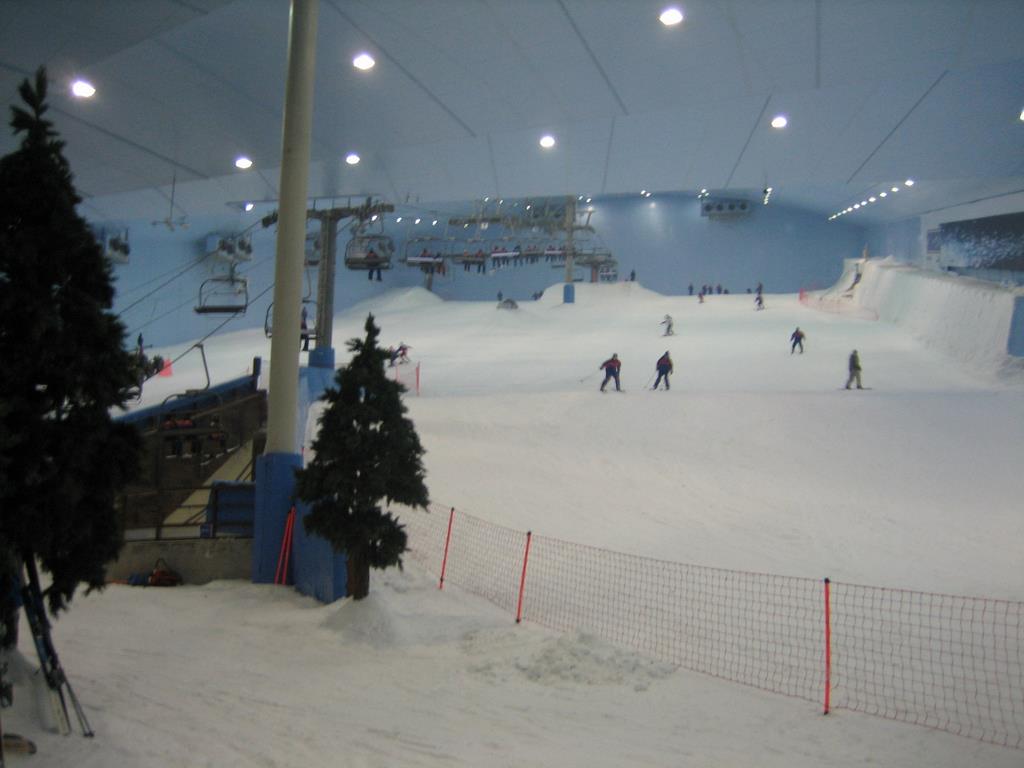
And in the center of it all is Ski Dubai, an indoor, downhill ski resort in the middle of the desert.

Thanks to good insulation, a 15 foot thick roof, and buckets of money, Ski Dubai offers real snow, 5 downhill runs, sledding, snow boarding, and any thing else a snow bunny might need—including a ski school. Included in the $73 ticket price are lift tickets, skis, boots, and of course warm clothes—since most folks here don’t own parkas.


And for someone off to live at "home" it’s more than worth the cost.

http://www.skidxb.com


Wednesday, June 20, 2007

Things we never expected to see in Tanzania

As a companion to my previous post--here I have a sampling of things that surprised us about life in Dar es Salaam:

1. Miniature golf


I knew Dar had a reputation as being a "family friendly" city but I definately never expected to be taking the kids to play putt-putt. This place is called "Funky Orbits" and it opened in March. They have 9 holes of minature golf, a climbing wall, and a gigantic playground. The food is mediocre but they have a kids menu with macaroni and cheese.


2. Pirates of the Caribbean


There are two theaters in town. One mainly shows Bollywood films and the other shows American films. Still we never figured that we'd be seeing Pirates of the Caribbean on opening weekend, in full stereo sound. It was awesome and the kids (yes we took all three) were thrilled.


3. Strawberries and rhubarb


We knew we'd have more than our share of pineapple, mango, and coconuts. Imagine my surprise when I went to the market and found strawberries and rhubarb! Yes, we made a pie. Yes, it was very good.


4. The Pink Tower
Those who know us personally know that we are big believers in the Montessori system of education. We were really dismayed when we moved here and realized there were no Montessori schools nearby for Josie. However I recently learned of and visited a Montessori Training Center. It's not close enough to send Josie but they do have a workshop where you can purchase materials. (Emily and Johnnie, if you're reading this I hope you don't think Maria Montessori is rolling over in her grave because we are introducing some of these materials at home...)


5. Blue cheese and fresh pasta

There is an Italian deli in town. It's different from most American delis as there's no freshly sliced meats and cheeses...and it's about 10 times more expensive than a deli in the states. But they have imported cheese and incredibly yummy fresh taglitelle and ravioli. Sorry, no picture of the pasta. I ate it all.


6. Great pizza...delivered!


This is a recent discovery. There are plenty of pizza places in town but this one is particularly good--and--they deliver. We even got a Mediterranean pizza with red peppers, black olives and feta! How awesome is that???


Why is it that practically this whole post is about food??

Things you don't see in the US

Unless you own an ice fishing cabin in Minnesota, here are some common things in Tanzania that most people don't see in the US:

These are our water tanks. Two hold 2000 liters each while one holds 3000 liters. We get our water trucked in 3 times a week because there is no city water out where we live (and we are not in a rural area at all).


This is our water filter. The water from the tap is not safe to drink so we have a water filter. To get your water you push the middle button. If you push the top button it will play a little tune so that you don't forget that your pot is filling.


This is our generator. The power goes off regularly so we have a heavy duty generator to run our lights and appliances until it comes back on. Lately we have had 24 hour power pretty much all the time but about 6 months ago it was off every day for 12 hours.


This is not the best picture but this is an African version of a security fence. Mortar is spread on top of a wall and while it is still wet broken shards of glass are set in it to deter any unwelcome guests.

Of course there are chickens in the US. However, they don't generally run free and I'm fairly certain that there aren't many in the suburbs. And yes, this one is crossing the road though I don't know why.


I don't know who designed this bathroom set-up but I wish they talked to me first. The shower is in the room on the left, the toilet is in the room on the right and the sink is in the hallway.


This is a very typical little shop (or duka). There are thousands of them in town. Inside the duka you can buy practically anything you might need from bread to toilet paper to rice to batteries to papayas to matches to soda. And, unlike in the US, the prices at these shops are cheaper than at the big supermarkets.


You might see a giraffe in the zoo but you'll never see one running free across the highway.

Sunday, June 17, 2007

It's time to build the ark

Thursday, 17 May 2007
Good greif, when folks say this is the "long rains" they aren't kidding. It is seriously wet. In full disclosure, this isn't a new occurance--it's been raining frequently for nearly 2 months. But that's the point. It's still raining. For example, for the past 2 days, it has rained literally non-stop. Pouring. And to top it off the frogs are having a field day. Last night they were so loud that they woke all of us up. These are just little frogs but there are so many of them now that they can wake up an entire family sleeping with the A/C and fans running (FYI, the fans aren't for cooling so much as shooing away any errant mosquitoes that got in when Josie or Ben or Josh left the door open--which I assure you doesn't happen often--before breakfast). All this rain has, of course, wreaked havoc on the roads. It now takes the kids about 15 minutes longer to get home on the bus because the roads are so muddy or washed out. Today Josie and I walked from our house to go get a newspaper. The paper seller has his stall around the corner from us (what is normally about a 7 minute walk by myself or 15 minutes with Josie). Right next to the stand there is a section where the road is really bad. I mean really bad. It's so bad that many folks will drive 2 km out of their way just to avoid a 100 foot section. Of course, if you have two school age boys--they will ask you to drive 2 km out of your way so that you can drive through that particular road. This section of the road is currently a small lake. I figured it would be. But what I didn't figure was that it's so bad that there are aquatic animals living the water. That's right--the water in the road is so deep, and so big, and been there for so long that there animals living in there. I couldn't tell you what kind of animal as I was on the other side of the road--but there was something swimming around in that puddle--and it wasn't some creature that got stuck or was just crossing over. This thing was living there, in the water, in the middle of the road, next to the newspaper stand.
I know come July, when Dar gets an average of about 1 inch of rain or less that I'll be biting my tongue but for now I just wish I could go ahead and clean the mildew on the porch with some bleach, say kwaheri to the frogs and the puddle-dwelling mystery critter and know that they won't be returning until the "short rains".


McGyver's got nothing on Africans

Saturday, 12 May 2007
Africans are nothing if not resourceful. I've known this for a long time--both Bob and I served as Peace Corps volunteers in Kenya, so we are used to how people squeak by on very little. When we came back to Tanzania this time we were living a decidedly different life. First and foremost, Bob was not working as a volunteer. Oh and we had three kids this time...But as we quickly realized, many things were pretty similar: people were friendly, service was slow, roads were bad, etc, etc. So I guess the resourcefulness should not have surprised me, but it did. Folks here are amazing at making something out of nothing. It really is impressive how they have embodied the spirit of necessity being the mother of invention. Here's an example..or two.
We have a gardener who works for us. His name is Mr. Ngowi and he is a really lovely person. He missed his calling in life as he is the quintissential teacher. He loves teaching me Swahili and he insists that I say everything correctly. He even teaches the kids Swahili. During lunch and after work he does the reverse and teaches English to the housekeeper and guard. we've all taken to calling him "mwalimu" which is Swahili for teacher. Anyway, Mr Ngowi calls me outside one day and tells me that there is a "shida ya bomba ya maji" or a problem with the water pipe. Sure enough there is a puddle in our driveway and little bubbles indicating a broken pipe below. Of course, like any good problem, this has occured at 4 PM on Friday. But the need to get it fixed is serious because the water from the pipe comes straight from our water tank and if it all leaks out we won't have any left. I tell him I'll call the person in charge of house repairs but he tells me to wait--that he wants to look at it first. So he digs up the pipe with a stone from the driveway (it was only about 6 inches underground) and we see that it is leaking from an elbow where the pipe branches between our house and the outside faucet. Mr Ngowi walks over to his bicycle and rifles around for a moment and comes back with a scrap of inner tube and a plastic bag. He digs a little furrow to drain away the still leaking water (we can't shut off the water from the tank) then proceeds to wrap the pipe in plastic and then tie the whole thing tight with the tire tube. And amazingly, it worked! My hope was that it would hold over the weekend until we could get a plumber in to fix the elbow but it's now been 4 weeks and it's still working.
Here's another story of resourcefulness. In mid April I went away on a 4 day language trip to Zanzibar. It was super cool and I promise to share pictures and stories about it soon. Because Bob works long hours (7 AM-6 PM) we knew that we would need some help while I was gone with watching the kids and cooking. Our friend recommended someone to us so we hired her for the week. Stella would come over in the afternoon and play with the kids and make dinner. Stella is a damn good cook. Josie adores her and together they make cakes and juice. Anyway, while I was gone Stella made a particularly good dinner and afterwards brought out a chocolate cake. This would not hav been nearly so surprising except that we didn't have any chocolate in the house! We didn't have cocoa powder, chocolate chips, baking chocolate--none of that. Finally Bob asked her how she did it and she showed him a single serving ready-made pudding cup. She took that and turned it into a family size chocolate cake. I don't know how she did it but I'm suitably impressed.
Oh and after that we hired Stella to come every week. Anybody who can make a cake out of nothing is a friend of mine. We may never eat out again.

New York Times Article on Tanzania

April 20, 2007
Op-Ed Columnist
‘Patient’ Capital for an Africa That Can’t Wait
By THOMAS L. FRIEDMAN
Last week, I was touring northern Tanzania when our car passed the small town of Karatu and we suddenly came upon an open field splashed with colors so bright and varied it looked from afar as if someone had painted a 30-color rainbow on the landscape.
As we got closer, I discovered that it was Karatu’s huge clothing market. Merchants had laid out blankets piled with multicolored shirts, pants and dresses, much of it used clothing from Europe, and were hawking their goods.
This was not Nordstrom. A man with a tape measure dangling from his back pocket and a megaphone in his hand was shouting: “A thousand shillings for these trousers. It’s like giving them away.” Men and women, themselves dressed in brightly colored native Tanzanian garments, sifted through the mounds of clothing, holding shirts or slacks up against their bodies to see if they fit.
Scenes like this remind you that Africa is neither all tragedy nor all renaissance. It is a diverse continent that’s struggling to find its way in the global economy and has both of these extremes, but is much more in a middle place that looks like that field in Karatu: a wild, unregulated, informal, individual brand of capitalism, which we need to channel into formal companies that can grow and scale up, even with corrupt governance.
Africa needs many things, but most of all it needs capitalists who can start and run legal companies. More Bill Gateses, fewer foundations. People grow out of poverty when they create small businesses that employ their neighbors. Nothing else lasts.
Whenever you read about capital flowing into Africa, though, it tends to be from big lenders like the World Bank, which have very strict criteria and work on big projects, or from microfinanciers, giving out $50 to a woman to buy a sewing machine. Microfinance has a role, but many people don’t want the pressure of being an entrepreneur. They want the stability and prosperity of a job created by capitalist risk takers and innovators. See India.
In some ways what Africa needs most today is more “patient” capital to spur its would-be capitalists. Patient capital has all the discipline of venture capital — demanding a return, and therefore rigor in how it is deployed — but expecting a return that is more in the 5 to 10 percent range, rather than the 35 percent that venture capitalists look for, and with a longer payback period.
A good example of what happens when you combine patient capital, talent and innovation in Africa is the Kenyan company Advanced Bio-Extracts (ABE), headed by Patrick Henfrey. He and his partners put together a fascinating group of both white and black African farmers and scientists to build the first company in Africa to cultivate the green leafy plant artemisia, often called sweet wormwood, and transform it into pharmaceutical grade artemisinin — a botanical extract that is the key ingredient in a new generation of low-cost, effective malaria treatments commonly known as artemisinin-based combination therapies (ACTs). Malaria still kills nearly one million people in Africa every year, more than H.I.V.-AIDS.
From its factory outside Nairobi, ABE is not only processing the feedstock for the drug, but has also contracted with 7,000 farmers, most with small farms, to grow artemisia in Kenya, Tanzania and Uganda. The crop gives farmers four times the financial yield of corn.
“We are commercializing a product that had never been commercialized,” Mr. Henfrey said. To make it possible, though, the founders had to not only scrape together all their own money, but also had to find investors, like the Swiss drug giant Novartis and the Acumen Fund, a nonprofit venture capital investor based in the U.S., to put up patient risk capital. (Banks demanded collateral that ABE did not have.)
“Those little windows of support make these things happen,” Mr. Henfrey said. “We could not have done it otherwise.”
Nthenya Mule, Acumen’s Kenya country director, commented to me that the stereotype of Africa is that it is hopeless and just waiting around for the West to come to its rescue. In reality, she added, “there are positive things happening in Africa, but they are not happening overnight, and some are happening quietly. ABE is exemplary. You will not see it as front-page news, but in 18 months they set up a factory with 160 people interfacing with 7,000 farmers and supplying one of the major pharma companies in the world.
“Those stories need to be talked about. It is critical to see things in action. A pothole in the road does not require a workshop. Fill it. We need a new kind of drug — let’s go out and make it instead of let’s talk about it for the hundredth time.”
Last Updated ( Tuesday, 24 April 2007 )

IST


Friday, 06 April 2007
Josh and Ben’s school

Many of you have asked us about the children’s new school. It is called the International School of Tanganyika. A historical note: previously, Tanzania was two separate countries—Tanganyika on the mainland and the islands of Zanzibar. When the country was united it took on the name Tanzania incorporating elements of both regions. And no, I don’t know why the school is still called Tanganyika as opposed to Tanzania…


The school, generally referred to as IST, has two campuses—primary and secondary. The secondary school is located around the corner from our house but the primary school, where Josh and Ben go, is farther away. It’s too bad it isn’t the other way around but oh well. The campus of the primary school is large and pretty. There are several rows of buildings with courtyards in the center. All around are large trees and flowering plants. The school has a music room, library, art room, multipurpose hall, and swimming pool.
The school is very different from what we are used to in the US. Previously the kids were in a Montessori school and IST is pretty traditional in structure. Ben is in EC3 which is their equivalent of kindergarten.


Josh is in second grade. IST is strong in social and extracurricular activities but somewhat weak in academics. It has been frustrating to realize that we will have to supplement their academic work at home; our hope is that the other benefits of living in Tanzania—seeing a new culture, learning a new language, and visiting places in Africa will offset these shortcomings.
Nonetheless, the kids like it there a lot and have settled in very well. Both Josh and Ben love the fact that they get to go swimming as a part of school. They each go once a week and it is the highlight of their day. At the end of the term they had a “swimming carnival”. There were all sorts of games and races and the kids had a blast. They had races where they swam through hoops and dove for things on the bottom.
Just recently Josh’s grade produced a cute and very enjoyable play called “Once Upon A Lily Pad”. The only thing the kids didn’t do was write the play but otherwise they were responsible for everything related to it. There were actors, singers, producers, costume designers, set designers, etc. Joshua was an advertiser which meant he got to make posters and sell tickets. He also sang in the chorus. His class practiced really hard for the play—especially with singing the songs. On the night of the play Joshua was so excited! Each child introduced themselves and told the audience what their role was in the play. I thought Josh might talk for 15 minutes but he did great! Each child also had a special T-shirt with their title and got to be decorated as a frog or a ladybug (Josh picked a frog). The play was really cute—it was the story of two little frogs learning what they are good at (jumping). Everyone did awesome and we were so proud!


This is totally unrelated but have I mentioned what a joker Josie is???

Benny's birthday


Tuesday, 20 March 2007
Ben turned 6 a few days ago. We celebrated it a day early with brownies at his school... Later that same night we went out to dinner at a restaurant called Spur. It is a South African chain and is the closest thing we have here to an American style restaurant. The place is a bit bizarre as it is supposed to have a “western” feel (as in Wild West) so their mascot is an Indian chief. But it’s got booth seating, a kids menu, crayons and coloring, and an inside play space (a la the kind at McDonalds). Needless to say the kids had a blast.


The next day was Ben’s actual birthday. It was a Saturday so we went to the beach south of town. It isn’t very far but you have to take a ferry to get there. The ferry crosses an inlet that goes inland from town. The ferry ride itself is only about 10 minutes but the line to wait for the ferry is quite a bit longer. I think we had to wait about 45 minutes for our turn. Passengers pay 100 Tanzanian shillings to cross which is about 8 cents. We had a car so it cost us 1100 shillings which is still less than a dollar. We went to a place called Kipepeo (butterfly) resort. This place is not very fancy but it has everything we need for a day at the beach. The water and beach are lovely and there are little thatched hut bandas (an open air tent) that you can sit under in the shade. They will bring you a plastic table and chair and you can sit in the shade, watch the water and have a drink.


The kids had enough fun so that at the end of the day they all fell asleep on the way home.


Later that night we had tacos for dinner and cake afterwards.


It was a good birthday.

Kwenda dukani (going to the store)


Sunday, 18 March 2007
Shopping in Tanzania is a lot different than shopping in the US. It seems like we spend a lot of time shopping. Perhaps it is because we’ve recently arrived and need to get a lot of things or maybe it’s because we only seem to buy smaller amounts at a time. Either way, I spend a lot of time getting food. And a lot of money too. Food here is either really really cheap or ridiculously expensive. Case in point: passion fruit and cereal. Passion fruit in the United States generally costs at least $1 each—often times it is $1.49 each. I know this because they are Bob’s favorite fruit. Here in Tanzania they cost 80 cents for a kilo! Each kilo has about 20 passion fruit so that’s about 4 cents each. (And just a tidbit for folks who might be visiting—there are many different varieties of passion fruit—some are for eating and some are for making juice. The really yummy ones are dark purple, almost black. The yellow ones are for juice. Those are good too but a little more sour). Anyway, the point is passion fruit are really good and really cheap. Cereal, on the other hand, is not cheap. Not by a long shot. The cost for a box of cereal ranges from 7,000-10,000 Tanzanian Shillings; that is between $6 and $9 a box! And the milk that you pour on it isn’t much cheaper. Most of the milk sold in Tanzania is the long-life UHT milk (like the Parmalat brand in the US). This costs about $1.50/liter or $6/gallon. In all, it makes for an expensive breakfast especially when you’ve got three kids who average 3 gallons of milk a week. Fortunately we are lucky and can get dry goods shipped to us in Tanzania through the diplomatic pouch. It makes a world of a difference (especially if you use CVS.com which has free shippingJ).
Shopping for food in Tanzania is not like the US. They do have “supermarkets” but what qualifies as a supermarket is not even remotely close to a Publix or Kroger. I think supermarkets here are defined by having a shopping cart more than anything else. The nearest supermarket to us is called Shoprite. It is a South African chain, and this particular location has a whopping 4 aisles! It’s about the size of a convienance store—maybe a little smaller. I’m actually not much of a fan of this particular Shoprite as they don’t have a generator so when the power goes out (which is all the time) then the food spoils. Whenever we need food and the power has been off then we make sure we go to Village Market. This is farther way (but still only about 5 minutes drive) but it is a very nice store. Yes, it is also small but it has a generator so all the food stays cold and it also has a little bakery and meat counter. It’s also very clean and bright. A third store near us is Srijees. Srijees is Bob’s favorite store. He likes them because they are cheap and have everything (yes, you probably could get a kitchen sink there).
Oh but here’s the twist—you don’t get your produce at the supermarket. Yes, they do sell produce (a little) but pretty much everyone gets their fruits and vegetables from the nearest fruit stand or seller.


There is one about 10 minutes walk from our house. It is inside a tiny semi-permanent building made out of corrugated sheet metal. Inside it is super cramped. That’s because it is wedged with people and food. They sell all kinds of produce—bananas, mangos, tomatoes, onions, potatoes, lettuce, green peppers, rosemary, pineapples, cucumbers, watermelons, limes, coconuts and of course, passion fruit. Heck, they even sell bok choy and asparagus and last Friday I saw some nice broccoli. A few times a week I will trek down to the fruit stand with my basket. Since we don’t have a car yet and Bob is usually at work I am limited to getting what I can carry (so not many watermelons during the week). In some places you would be expected to bargain but not at this place. The prices are pretty much set and they are reasonable for things that are grown locally. Sometimes on my way home I will stop and buy flowers. I recently got an enormous bouquet of tuber roses, birds of paradise and something else for $3.50. While it is a nuisance to schlep all this stuff home in weather over 90 degrees, I really don’t mind (unless I’m also schlepping a kid and then it’s a total drag). I like the fact that when you walk to the store here everyone will say hi to you. Even though Dar is the capital, it is still very much a small town.
Here's a picture of a recent shopping purchase. The things that look like potatoes are the passion fruit. This cost about $9 in total.

Tumefika Tanzania (We've arrived in Tanzania)!


14 March 2007


After a lot of stress and work, and worry we’ve finally arrived in Dar es Salaam. We’ve now been here just over 3 weeks and are slowly getting settled into our house and into a routine.

Here’s a little information about where we are living. We are living in Dar es Salaam, Tanzania. This is a coastal city in East Africa located on the Indian Ocean. We are 7 degrees south of the equator. We live slightly outside the city of Dar es Salaam on the Msasani peninsula. It is a relatively well to do area, a lot of ambassadors live on the peninsula (though not so near us). The houses here generally all are on fenced compounds—some are very large and others (like ours) are more modest.


Our house is a one story ranch with 4 bedrooms. It has two bathrooms—though unlike the US, the toilet and shower are in their own separate room. The house also has a living room, dining room and screened porch. The kitchen has all the amenities of the US (minus a dishwasher). We have an oven, microwave, and refrigerator. Our house came furnished which is nice though it is rather bland (everything is white—couch, chair, curtains, walls, even the floors).
Here is a picture of our living room:

All the rooms have ceiling fans and air conditioners. The AC units here are different from the US. Each room has its own unit but instead of being in a window, they are attached to the wall—up near the ceiling. So each room has a little remote for working the AC—the challenge is that not all the units work all that well. The one in Josh and Ben’s room dripped water all over Ben’s bed one day. Thankfully we got that fixed right away. The best part of our house is the yard. It isn’t gigantic but it is really pretty. We have several coconut trees and lots of flowering bushes and trees. It’s funny to see what are houseplants in the US, growing in the back yard! We set up the soccer goals so that the kids can play soccer, though truthfully it has been a bit too hot to play.

Life on the equator is a bit of an adjustment. The sun rises and sets at the same time every day (6:30). While it is nice having the sun come up early (especially in February), I keep equating hot weather with summer so when it’s dark at 7:00 PM you somehow end up feeling like you missed something. Having the sun set so early also takes some planning. There are no street lights here so when the sun goes down it gets DARK. One of the first days we were here we went out to dinner and by the time we finished it was completely dark. Needless to say we got totally lost because the majority of the streets are unnamed dirt roads. So even though as the crow flies we were less than half a kilometer from our house we finally ended up driving the only way we knew for sure to get home which was something around 10 KM and entailed driving about as far out of our way as we could just to circle back and get home. One of those “in retrospect, it’s funny” moments.

Pasaka (Easter)


Monday, 07 May 2007
Here are some Easter pictures. We dyed eggs the day before. I wasn't sure if they would look nice since you can only get brown eggs here but they actually turned out really lovely. Many of the eggs have speckles and are varying shades of brown so when they were dyed the colors were speckled and unusual. The green eggs came almost exactly the same color as grass which probably explains why one egg was never found. That Easter bunny can really hide eggs well!


That's all folks!